
How to Make Research Papers Easier to Read Without Oversimplifying Them
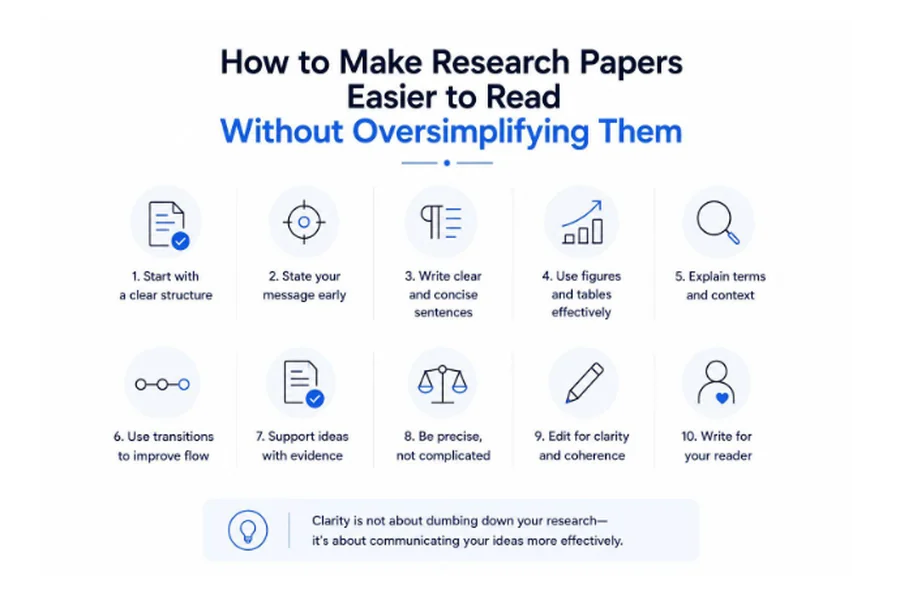
Research papers often deal with complex subjects, specialised terminology, and detailed evidence. That does not mean they have to be difficult to read. Researchers can use a grammar checker to identify language issues during revision and an AI detector when reviewing text that may have been produced or substantially modified with AI. These tools can support the writing process, but readability still depends on how clearly researchers organise their ideas, explain their findings, and communicate technical information.
Why Readability Matters in Research Papers
A research paper can contain valuable findings but still be difficult to understand if the writing is poorly organised. Readers need to follow the research question, understand the methodology, interpret the results, and connect the findings with the conclusions.
Researchers also write for audiences with different levels of familiarity with a subject. A specialist may understand technical terminology immediately, while a researcher from another discipline may need additional context.
Readable academic writing does not mean making research informal or removing technical detail. It means presenting complex information in a way that allows readers to understand its meaning without unnecessary difficulty.
Preserve Technical Meaning
The first rule of improving readability is to protect the accuracy of the research.
Some technical terms exist because they describe specific concepts. Replacing them with simpler words can sometimes change the meaning rather than improve the writing.
Before replacing a specialised term, ask whether the term is necessary for accuracy. If it is, keep it and provide enough context for the intended audience.
If a simpler expression communicates exactly the same idea, there is usually little reason to use the more complicated version.
The goal is to make the language clearer without changing the substance of the research.
Choose Precise Words
Longer expressions are not always more appropriate for academic writing.
Consider these examples:
The results demonstrate that the intervention was effective.
Compared with:
The results provide an indication regarding the effectiveness of the intervention.
The second sentence is longer but does not provide additional information.
Researchers should choose words based on accuracy and context rather than complexity. A precise word can often communicate an idea more effectively than a longer phrase.
During revision, look for expressions that can be shortened without changing their meaning.
Break Up Overly Long Sentences
Long sentences are not automatically a problem. Academic writing sometimes requires sentences that contain several related ideas.
The problem occurs when a single sentence contains too many separate points.
For example:
The study examined the relationship between sleep duration and academic performance among university students, while also considering differences in study schedules and demographic characteristics, which were included because previous research had suggested that these factors could influence the relationship observed in the sample.
The information can be separated:
The study examined the relationship between sleep duration and academic performance among university students. It also considered differences in study schedules and demographic characteristics. Previous research suggested that these factors could influence the relationship observed in the sample.
The second version does not remove important information. It gives each idea more space.
When revising a long sentence, identify the individual ideas it contains. If those ideas can stand independently, consider separating them.
Give Each Paragraph a Clear Purpose
A paragraph should have a clear reason for being in the paper.
One paragraph might introduce a concept, another might explain a method, and another might discuss the significance of a finding. Problems occur when unrelated ideas are placed together.
During revision, ask:
- What is the main point of this paragraph?
- Does the opening sentence introduce that point?
- Does the supporting information relate to it?
- Does the paragraph connect naturally with the previous one?
- Does it prepare the reader for the next idea?
If a paragraph appears to have two different purposes, it may need to be divided.
Use Transitions Carefully
Readers need to understand how ideas relate to each other.
Words such as “however,” “therefore,” “similarly,” and “in contrast” can make those relationships clearer.
For example:
Previous studies have identified a relationship between sleep quality and academic performance. However, fewer studies have examined whether this relationship differs across age groups.
The transition helps the reader understand that the second sentence introduces a limitation or contrast.
However, transitions should not be added simply to make academic writing sound more formal. The relationship between the ideas should be clear first.
Avoid Unnecessary Jargon
Technical terminology is often necessary in research papers. Unnecessary jargon is different.
Researchers should consider who will read the paper. A highly specialised term may be appropriate for a narrow audience but may need explanation when the paper is intended for researchers from several disciplines.
For example, a term that is widely understood within one field may be unfamiliar to readers outside that field.
When a technical term is essential, explain it where appropriate. When it is not essential, consider whether a more accessible expression can communicate the same idea accurately.
Use Active and Passive Voice Appropriately
Passive voice has an important role in academic writing.
For example:
The samples were stored at 4°C before analysis.
The focus here is on the samples and the procedure rather than the person who performed the action.
However, passive constructions can make some sentences unnecessarily long.
Compare:
An analysis of the collected data was conducted by the research team.
with:
The research team analysed the collected data.
The second sentence is more direct.
Researchers should not try to eliminate passive voice completely. Instead, they should choose the structure that communicates the intended information most clearly.
Make the Introduction Easy to Follow
The introduction gives readers the context they need to understand the research.
A strong introduction usually establishes the broader subject, explains what previous research has found, identifies a gap or unresolved issue, and introduces the purpose of the study.
Problems arise when introductions contain large amounts of background information before explaining why the study matters.
Move gradually from the general context toward the specific research question. This gives readers a clear path into the subject.
Keep the Methods Section Organised
The methods section needs enough detail for readers to understand how the study was conducted.
A large amount of technical information does not have to result in a confusing section.
Use appropriate subheadings when the paper contains several procedures. Present processes in a logical order and define terms that readers need to understand.
If several methods were used, explain them according to their sequence or purpose.
Clear organisation allows readers to focus on the research procedure instead of trying to work out how different parts of the method relate to each other.
Present Findings Clearly
The results section should make the important findings easy to locate.
Avoid placing several unrelated results inside one long paragraph. Use tables and figures when they make numerical or comparative information easier to understand.
The surrounding text should explain what the reader needs to notice rather than simply repeating every value presented in a table.
The discussion can then focus on what the results mean, how they relate to previous research, and what limitations should be considered.
Keeping evidence and interpretation appropriately separated can make the paper easier to follow.
Use Writing Tools During Revision
Writing tools can help researchers identify language problems that may be difficult to notice during a manual review.
A tool such as Trinka can support the review of grammar, sentence structure, word choice, and other aspects of academic writing. Researchers should still evaluate each suggestion because automated tools may not fully understand specialised terminology or the intended meaning of a particular scientific statement.
It is generally more useful to review the content and structure before performing detailed language corrections. There is little benefit in spending time polishing a sentence that may later be removed because the argument has changed.
Read the Paper From the Reader’s Perspective
Researchers are familiar with their own work, which can make certain problems difficult to notice.
During the final review, try to read the paper as someone encountering the study for the first time.
Look for places where:
- A technical term appears without enough explanation.
- A paragraph introduces an idea without sufficient context.
- A sentence contains several unrelated points.
- The connection between two paragraphs is unclear.
- An important result is difficult to find.
- A conclusion appears before the evidence supporting it.
- A sentence could have more than one interpretation.
Reading sections aloud can also reveal awkward sentence structures and missing connections between ideas.
Ask Someone Less Familiar With the Study to Read It
A colleague who works in the same research area may understand a difficult sentence because they already know the subject.
If possible, ask someone with academic experience but less familiarity with the specific research to read an important section.
Their questions can reveal where the paper needs more explanation.
If a reader repeatedly asks what a particular term means or why a result matters, the paper may need additional context.
Do Not Confuse Simplicity With Quality
Research writing should be accessible, but accessibility does not mean removing complexity from the research.
Some studies involve complex statistical methods, theoretical models, specialised procedures, or technical terminology. Those elements cannot always be simplified without losing accuracy.
The better approach is to make the relationships between those elements easier to understand.
A technically complex paper can still have clear sentences, logical paragraphs, useful headings, and a well organised argument.
Perform a Readability Review Before Submission
A final readability review can be easier when completed in stages.
1. Check the structure
Make sure the research question, methodology, findings, and conclusions follow a logical progression.
2. Check the paragraphs
Make sure each paragraph has a clear purpose and connects with the surrounding content.
3. Check the sentences
Look for unnecessary length, unclear references, repeated ideas, and awkward constructions.
4. Check the language
Review grammar, spelling, punctuation, terminology, and word choice.
5. Check the final document
Read the complete paper from beginning to end. Make sure the language is consistent and that the final version communicates the research accurately.
Conclusion
Making a research paper easier to read does not require removing technical information or reducing complex ideas to simple explanations. It requires researchers to present those ideas with greater precision and better organisation.
Clear writing comes from careful choices about words, sentences, paragraphs, structure, and explanations. Tools such as Trinka can support the language review, but the researcher remains responsible for the accuracy, meaning, and final wording of the paper.
A readable research paper allows readers to spend their time understanding the research rather than working through unnecessarily complicated language. When technical accuracy and clear communication work together, complex research can remain rigorous while becoming easier to understand.