
From 2D Ideas to 3D Reality: How Hi3D Makes AI-Powered 3D Creation Easier for Everyone
The way people create digital content is changing. With the development of AI technology and 3D printing, the process of turning an idea into a physical object is becoming faster and more accessible. What once required professional modeling skills and complicated software can now begin with a simple image, a sentence, or a creative concept.
AI 3D printing is gradually becoming an important part of modern creativity. Designers, artists, makers, educators, and everyday users are exploring new ways to transform digital inspiration into real objects. However, the challenge is no longer only about printing a model. Creating a high-quality 3D asset before printing remains one of the biggest barriers for many users.
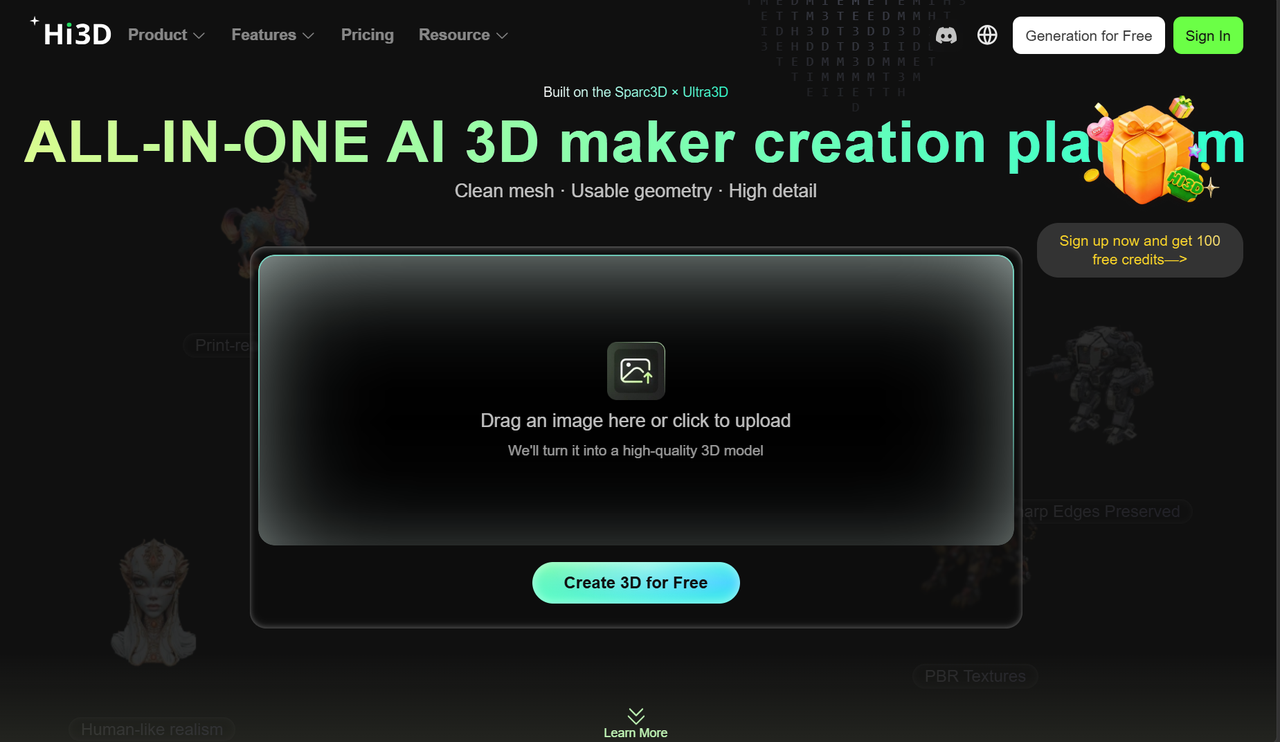
Hi3D is built to solve this challenge. By combining AI-generated 3D models, intelligent texture creation, and practical preparation tools, Hi3D helps users move from ideas to printable creations more efficiently. Through features such as image-to-3D generation, text-to-3D creation, AI texture generation, multi-color printing, model splitting, and smart arrangement, Hi3D provides a more complete workflow for modern 3D creators.
With the release of Hi3D V3.0, the platform further improves the quality and usability of AI-generated 3D assets, bringing AI creation closer to real production needs.
1. Why Turning Ideas into 3D Models Is Still a Challenge
The growth of 3D printing has changed the way people design and manufacture objects. From personalized figures and creative decorations to prototypes and educational models, 3D printing gives individuals more freedom to create customized products.
However, behind every printed object is a 3D model. For many users, creating this digital foundation remains the most difficult part of the process.
Traditional 3D modeling requires knowledge of professional tools, geometry, sculpting, and rendering. Beginners often find it difficult to start, while experienced designers may spend a large amount of time completing repetitive modeling tasks.
This creates a gap between creative ideas and physical results. Many people have images, sketches, or concepts they want to turn into objects, but they lack the skills or time required to build a complete model from scratch.
AI-powered 3D creation provides a new solution. Instead of starting from a blank workspace, users can provide existing visual references or descriptions and allow AI to assist with model creation.
Hi3D focuses on reducing this barrier. As an AI 3D model maker, Hi3D helps users create 3D assets from simpler inputs, making the transition from imagination to digital model more efficient.
2. Creating 3D Models Directly from Images with Hi3D
Images are often the starting point of creative ideas. A character illustration, product concept, personal photo, or design reference can contain valuable information, but transforming a 2D image into a complete 3D model has traditionally required advanced modeling skills.
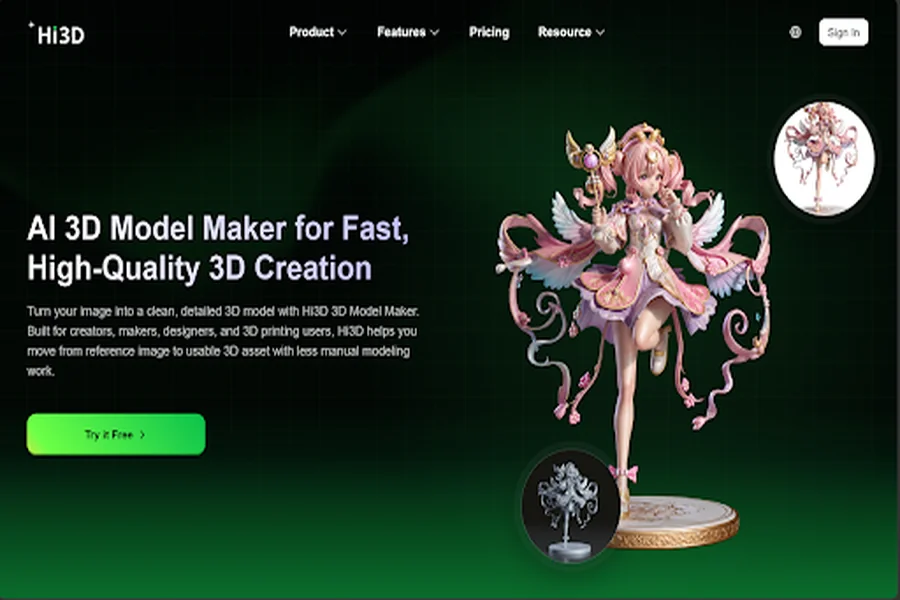
Hi3D changes this process by allowing users to generate 3D models directly from images, helping bridge the gap between visual creativity and three-dimensional production.
2.1 Transforming 2D Visual Concepts into 3D Models
The image to 3D model AI feature allows users to convert 2D references into three-dimensional assets. Instead of manually creating shapes, adjusting surfaces, and reconstructing details, users can start with an image and let AI analyze the visual information to generate a corresponding 3D model.
This capability is useful for different types of creators.
For artists, a 2D character illustration can become a physical collectible or display figure. For designers, a product concept image can quickly become a prototype for further development. For individual users, personal images can be transformed into customized 3D creations.
The biggest advantage of image-based generation is that it allows users to focus on creativity instead of spending most of their time learning complex modeling workflows.
A creator does not need to think about every technical modeling step at the beginning. Instead, they can start with an existing idea and explore how that idea can exist in three-dimensional space.
2.2 Making Creative Exploration Faster and More Flexible
Traditional modeling often requires creators to make decisions about structure, proportions, and details before seeing the final result. This can slow down the creative process, especially during the early exploration stage.
Hi3D provides a faster way to test ideas. Users can generate different concepts from visual references and explore possible directions before moving into detailed production.
For creators working on characters, collectibles, product concepts, or creative projects, this flexibility helps shorten the distance between imagination and experimentation.
3. Text-to-3D Creation Expands the Possibilities of AI Design
Images are not the only way people express ideas. Sometimes a concept exists only as a description, such as a unique character design, a futuristic product idea, or a creative object that has never been created before.
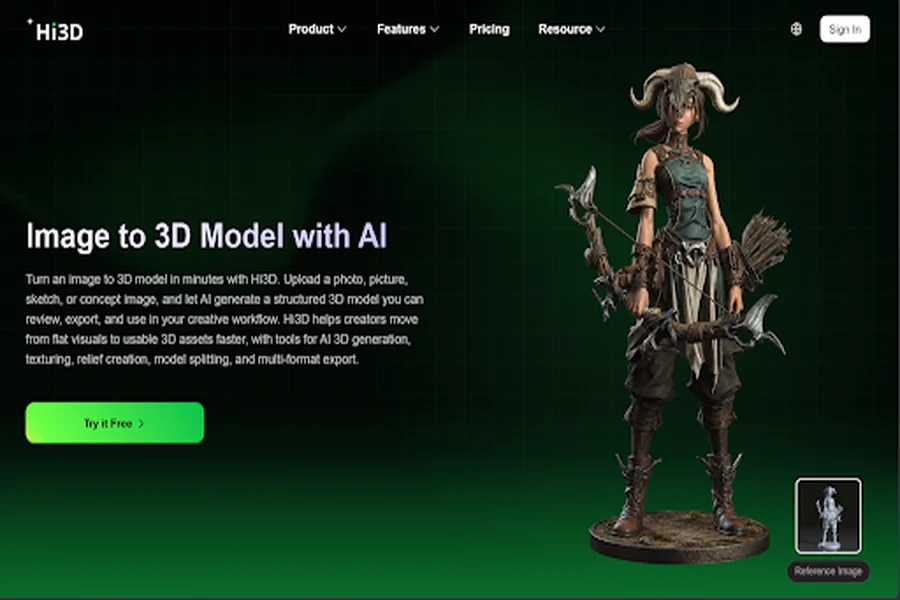
Hi3D also supports text-based creation, allowing users to describe their ideas and explore 3D possibilities through AI.
3.1 Turning Descriptions into Three-Dimensional Concepts
Text-to-3D generation allows users to begin with natural language instead of a finished image.
A user can describe an object, character, or design concept, and AI can help transform that idea into a 3D model. This approach provides a more direct connection between imagination and creation.
For beginners, this lowers the entry barrier because they do not need professional modeling knowledge to start creating.
For experienced creators, text-based generation can become a useful tool for brainstorming. It allows them to quickly explore different concepts before selecting the most suitable direction for further refinement.
3.2 Supporting Different Types of Creators
The flexibility of AI-generated models makes Hi3D suitable for a wide range of users.
Artists can use it to explore new forms of character creation. Designers can use it to develop early product ideas. Educators can create visual learning materials. Makers can generate models that can later be prepared for 3D printing.
By making creation more accessible, AI 3D technology allows more people to participate in digital manufacturing.
4. AI Texture Generation Helps Create More Complete 3D Assets
A successful 3D model is not only defined by its shape. Surface details, colors, and materials also influence the final quality of the model.
Many AI-generated models can create impressive structures but still require additional work before they are ready for presentation or printing. Texture creation is often a time-consuming step because it involves detailed editing and manual adjustments.
Hi3D improves this stage through AI-powered texture generation, helping users create more visually complete models.
4.1 Adding Realistic Details with AI Texturing
The AI 3D model texture generator feature helps automatically create surface details for 3D models.
Instead of manually painting textures or adjusting every material detail, users can rely on AI assistance to improve the appearance of their models.
This is especially useful for projects where visual quality is important, including character figures, collectibles, product visualization, and creative designs.
For example, a character model can receive richer clothing patterns and surface details. A product prototype can display more realistic material effects. A digital artwork can become closer to a finished physical object.
4.2 Improving Texture Quality with Hi3D V3.0
Hi3D V3.0 brings further improvements to texture generation. According to the official release information, V3.0 increases texture output capability up to 8K and upgrades its self-developed UV completion algorithm, improving pattern edge clarity, color transition consistency, and the recognition of detailed textures after enlargement.
Higher-quality textures allow AI-generated models to maintain more visual information and provide stronger support for professional applications.
For creators, this means models generated by AI can better represent the original concept and become more suitable for display, editing, and printing.
5. Preparing AI Models for Real-World 3D Printing
Creating a model is only the first step. Before a digital asset becomes a physical object, users often need to solve additional problems, such as color management, model separation, and printing preparation.
Hi3D provides several tools to make this transition smoother.
5.1 Multi-Color Printing for More Detailed Physical Results
Hi3D’s multi-color printing feature helps transform AI-generated textured models into printable multi-color objects.
The feature focuses on improving color mapping between digital models and real filament materials. It can generate printable color regions, reduce unnecessary fragmented areas, and help users achieve better consistency between design intention and printing results.
This is especially valuable for creators producing colorful figures, personalized products, and collectible models.
5.2 Split-for-Printing and Smart Arrangement
For complex models, printing preparation can become a challenge. Large models may exceed printer size limitations, while detailed figures may require separate parts for easier assembly.
Hi3D’s split-for-printing feature helps divide models into printable components and supports automatic connector generation. It can separate areas such as the head, torso, arms, legs, weapons, and base, making complex models easier to produce.
Smart arrangement further improves the preparation process by helping arrange parts on the build plate, suggest printing orientations, and export 3MF files with recommended slicer settings.
These features help users move from AI-generated models toward actual printing workflows.
6. Hi3D V3.0: A New Generation of High-Precision AI 3D Models
The release of Hi3D V3.0 represents an important milestone in AI 3D creation. Instead of focusing only on generating attractive models, this version focuses on improving the overall quality and usability of AI-generated assets.
Hi3D V3.0 is introduced as a new-generation general AI 3D model. It improves geometric reconstruction resolution to 2048³ voxel-level, becoming the first commercially available AI 3D model with this level of precision. It also upgrades texture output to 8K and improves cross-view structure reasoning and self-developed UV completion technology.
6.1 Higher Accuracy for Complex Structures
One of the most important upgrades in V3.0 is improved geometric reconstruction.
The increase from 1536³ to 2048³ voxel-level resolution allows more details to be preserved. Small structures such as feather layers, scales, text edges, mechanical connections, and subtle surface changes can be represented more clearly.
This improvement helps AI-generated models become more suitable for detailed creative and production scenarios.
6.2 Better Understanding Across Multiple Views
Another key improvement is stronger structural stability.
Since a single image only provides limited information, AI needs to predict hidden areas and understand spatial relationships. Hi3D V3.0 improves multi-view structure reasoning, helping reduce issues caused by complex viewpoints and hidden sections.
This allows generated models to achieve better consistency when viewed, edited, or prepared for printing.
7. From Hi3D Evolution to Future AI 3D Applications
The development of Hi3D reflects the evolution of AI 3D technology from simple generation toward practical production.
Hi3D V1.0 introduced commercial AI image-to-3D generation with 1536³ voxel resolution. V2.0 improved geometry and texture integration, enhanced hidden structure completion, and created a more complete workflow. V3.0 continues this direction by improving geometric precision, complex structure handling, texture quality, and production-related functions.
These improvements support applications across different industries.
In 3D printing, users need accurate and printable models. In gaming and digital art, creators require detailed assets. In jewelry design, cultural products, education, e-commerce content, and industrial design, professionals also need reliable 3D models that can continue into further workflows.
Hi3D aims to reduce the gap between AI generation and real-world creation, allowing more users to access high-quality, editable, and printable 3D assets.
To celebrate the official release of Hi3D V3.0, Hi3D is opening a limited 48-hour free experience. From August 19, 2026, 00:00 to August 20, 2026, 24:00 (Beijing Time), users can access Hi3D V3.0 with unlimited usage during the experience period.
For creators who want to explore AI-powered 3D production, this is an opportunity to experience how images, words, and ideas can become detailed three-dimensional creations.