
Powered vs Passive Subwoofers: Which Setup Fits Your Car and Budget?
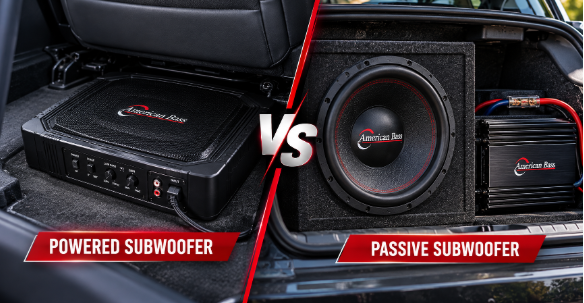
A powered subwoofer for car audio has the amplifier built in. A passive subwoofer needs a separate amp to run.
That one difference shapes your cost, your install, and your sound.
Powered is simple and fast, while passive gives you more power and control. This guide breaks down both. So you can pick the setup that fits your car and your budget.
What Is a Powered Subwoofer?
A powered subwoofer combines the sub, the box, and the amplifier in one unit. Everything is matched at the factory and ready to run.
- You wire it in once, and you are done
- The amp is sized to the sub already
- Most units are slim enough to fit under a seat
This is the easiest path to real bass. A powered subwoofer car setup skips the guesswork of matching parts yourself. For a simple, clean upgrade, ready-made subwoofer and amp packages give you everything in one box.
What Is a Passive Subwoofer?
A passive subwoofer is just the driver, with no amp inside. You pair it with a separate amplifier and often a separate box.
This takes more work, but it gives you more control. You choose the sub, the amp, and the box to match your exact goal. You can also push far more power than a built-in amp allows.
A passive setup is how most loud builds are made. It costs more and takes longer, yet it rewards the effort with output a powered unit cannot match.
Powered vs Passive: The Key Differences
Here is how the two compare on what matters most.
| Feature | Powered | Passive |
| Amplifier | Built in | Separate |
| Install | Fast and simple | Longer, more wiring |
| Space | Compact, fits tight spots | Needs box and amp room |
| Power ceiling | Modest | High |
| Cost to start | Lower | Higher |
The powered vs passive subwoofer choice comes down to effort against output. Powered wins on simplicity and space. Passive wins on power and control.
Which One Fits Your Car?
Your vehicle and your space often decide for you. A powered unit fits where a full setup cannot.
A compact powered subwoofer car unit slides under a seat or behind a console. It suits trucks, coupes, and small cars with no trunk room. If you want bass without losing cargo space, this is the answer.
A passive setup needs room for a box and an amp. It fits best in a sedan trunk or an SUV cargo area. When you have the space and want the output, passive is the stronger path.
Which One Fits Your Budget?
Both can start cheap, but they scale differently. Your budget sets more than the price tag.
A powered unit costs less to start, since it bundles everything into one purchase. A subwoofer for car with amp built in saves you from buying parts separately. It is the better value for a first build or a tight budget.
A passive setup costs more up front and more to expand. You buy the sub, the amp, and the box on their own. A car subwoofer kit bundles those parts to soften the cost, but passive still asks for more.
Matching Power the Right Way
Whichever you choose, power matching decides your sound. A powered unit handles this for you, but a passive setup is on you.
For a passive build, match the amp’s RMS output to your sub’s RMS rating. Too little power clips and damages the sub, while a close match stays clean. Choosing the right car audio amplifiers is the single biggest decision in a passive setup. Get it right and the sub performs exactly as built.
Can Your Electrical System Handle It?
Big passive builds pull serious current, and your car has to keep up. A powered unit draws less, so it rarely strains your electrical.
A high-power passive setup can outpace a stock alternator and battery. The result is dimming lights and voltage sag under bass. Check your electrical headroom before you commit to a big build. Our electrical load calculator shows what your system can support, so you choose a setup your car can actually run.
Pick the Setup That Fits Your Build!
The right choice depends entirely on your space, your budget, and your goal. Go powered for a fast, compact, affordable upgrade that just works. Go passive when you have the room, the budget, and the appetite for real output. Either way, match the power to the sub and build for your car.
American Bass builds powered and passive subwoofers, amplifiers, and the tools to match them from Twinsburg, Ohio. Our free calculators pair your gear in minutes. You can also find a trusted installer near you through our installer finder.
FAQs
Is a powered subwoofer good enough for my car?
Yes, for most daily drivers it is plenty. The best powered subwoofer car unit delivers clean, satisfying bass with a simple install. You step up to passive only when you want serious output.
Can I add more power to a powered subwoofer later?
Not really, since the amp is built in and fixed. If you want more output down the road, a passive setup is the better start. Powered units are best when you want simple and done.
Do powered subwoofers fit under a seat?
Many do, since most are slim and compact by design. They are built for tight spaces like trucks and small cars. Always measure your clearance before you buy.
Is a passive subwoofer worth the extra work?
It is, if you want maximum output and full control. You choose every part and push far more power. For a simple upgrade, though, powered saves you the effort.