
AI-Powered Test Automation: How to Make It Work in Practice
Traditional test automation promised faster releases and fewer defects. For many teams it delivered something else: brittle scripts that break with every UI change, growing maintenance backlogs and regression suites that take hours to run.
AI is changing that picture, but unevenly. The World Quality Report 2025 by Capgemini, OpenText and Sogeti found that 89% of organizations are piloting or deploying generative AI in quality engineering. Only 15% have scaled it across the enterprise. The main barriers are data privacy risks (67%), integration complexity (64%) and skill gaps (50%).
In other words, most teams have tried AI in testing. Far fewer have turned it into a workflow that runs reliably, release after release. The difference lies less in the tools than in how they are introduced.
Where AI adds value in the testing workflow
AI is most useful where testing is repetitive, data-heavy or fragile. These are the areas where teams see results soonest:
| Area | What AI does | Why it matters |
| Test case generation | Drafts test cases from requirements, user stories or existing code | Faster coverage of new features and edge cases |
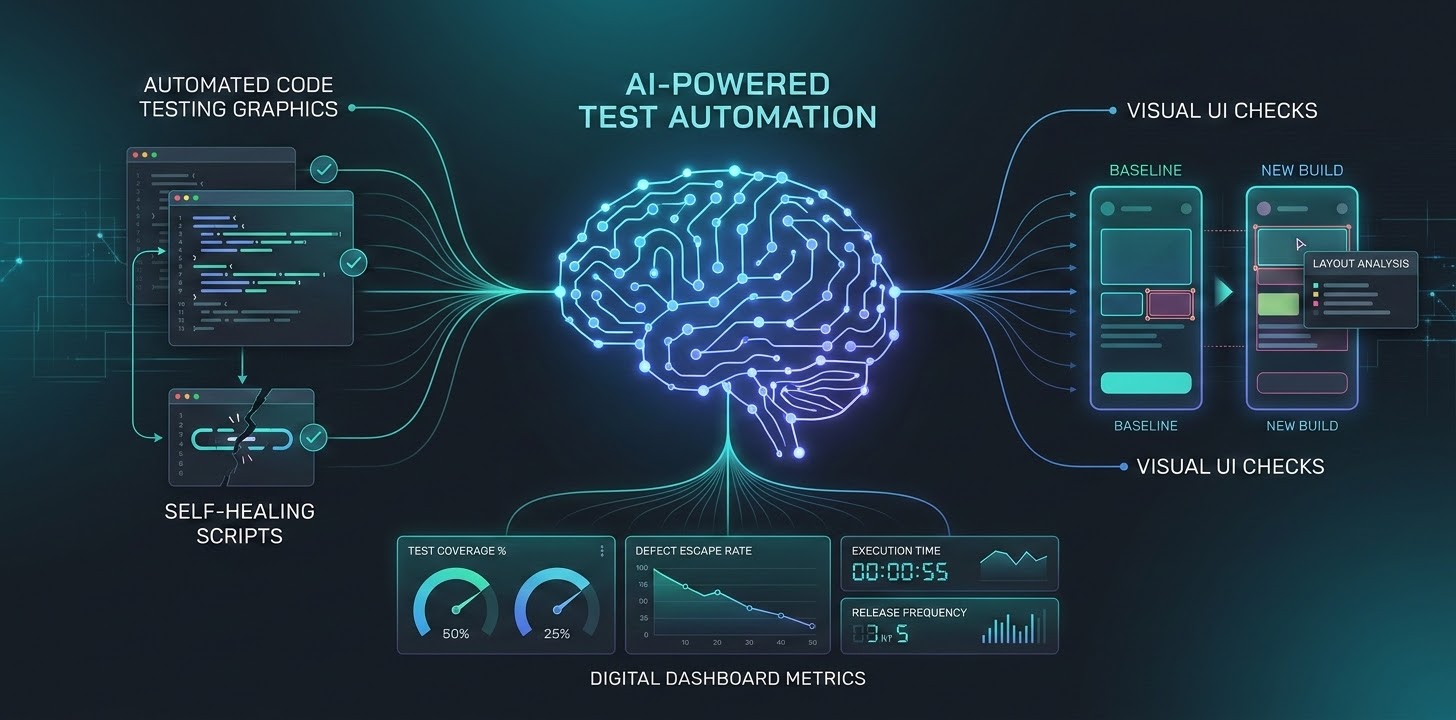
| Self-healing scripts | Detects UI changes and updates locators automatically | Less time spent fixing broken tests |
| Test prioritization | Selects the tests most likely to catch defects for a given code change | Shorter regression cycles in CI/CD |
| Test data generation | Creates realistic, privacy-safe synthetic data | Better coverage without exposing customer data |
| Failure analysis | Groups failures, flags flaky tests and suggests root causes | Faster triage and fewer false alarms |
| Visual testing | Compares screens and spots layout or rendering issues | Catches defects that functional checks miss |
None of these replace testers. They shift the job from writing and repairing scripts to designing test strategy, reviewing AI output and exploring the product where risk is highest.
Building an effective AI-assisted testing workflow
- Audit your current test suite. Find where time goes: flaky tests, slow regression runs, manual checks repeated every sprint. These are your best starting points.
- Fix the foundations first. AI amplifies what is already there. Stable test environments, clear naming, version-controlled test assets and a working CI/CD pipeline matter more than any tool choice.
- Start with one high-impact use case. Self-healing locators or test prioritization often show value within weeks. Set a baseline, such as hours spent on maintenance, and measure against it.
- Keep humans in the loop. Treat AI-generated tests like code from a new team member: review them, check what they actually assert and remove duplicates. Coverage numbers alone can be misleading.
- Integrate into the pipeline, not beside it. AI-driven checks should run where developers already work, triggered by commits and pull requests, with results in the same dashboards.
- Protect your data. Decide what code, logs and test data can be sent to which models. Use synthetic or masked data wherever possible.
- Upskill the QA team. Testers need skills in prompt design, reviewing model output and test strategy. This is where many organizations still fall short.
Pitfalls to avoid and metrics that matter
Common mistakes include:
- Automating a broken process. If your test strategy is unclear, AI will simply produce more unclear tests, faster.
- Trusting output blindly. Generated tests can pass while checking the wrong thing. Hallucinated assertions are a real risk.
- Tool sprawl. Several AI tools with overlapping features create integration overhead and inconsistent results.
- Ignoring flaky tests. Self-healing can hide genuine defects if every failure is “fixed” automatically. Set rules for what can be healed and what needs a human.
To judge whether AI is improving your testing, track:
- Test maintenance effort, in hours per sprint
- Regression cycle time
- Defect escape rate, meaning bugs found in production
- Share of flaky tests in the suite
- Release frequency and change failure rate
If these move in the right direction, the workflow is working. If only the number of tests grows, it isn’t.
From pilots to everyday practice
The gap between trying AI in testing and running it at scale is mostly about discipline: solid foundations, clear ownership and steady measurement. Teams that close it don’t just test faster. They spend their time on the testing that needs human judgment.
It also helps to learn from teams that have done it before. Quality engineering specialists such as KMS Technology, whose testing practice spans more than 15 years and which also developed the Katalon and Kobiton platforms, use AI to generate test cases and widen coverage within clients’ existing pipelines. Whether you build the capability in-house or with a partner, the lesson is the same: start small, keep people in the loop and let the results decide what scales next.