
Key Residential Home Maintenance Services for a Healthy Home

Essential System Upkeep: HVAC, Air Quality, and Climate Control
Your home’s climate control system is arguably its “lungs” and “heart.” When maintained properly, it ensures a constant flow of clean, tempered air, which is fundamental to your family’s health and comfort. Indoor air quality is directly influenced by how well your HVAC system is serviced. Using filters with the appropriate MERV (Minimum Efficiency Reporting Value) rating helps trap allergens and dust before they circulate through your living spaces. For most residential properties, a MERV 11 rating strikes an ideal balance between capturing airborne particles and maintaining consistent airflow to prevent motor strain.
Neglecting your climate control system often leads to reduced energy efficiency and premature equipment failure. To keep your system running at its peak, we recommend relying on expert HVAC services for bi-annual inspections. These professionals can identify issues—such as leaking refrigerant, worn capacitors, or ductwork breaches—that aren’t always visible to the untrained eye. Beyond professional help, simple habits like keeping the area around your outdoor condenser unit clear of leaves, grass clippings, and debris are vital for heat exchange efficiency.
Seasonal Residential Home Maintenance for Heating and Cooling Systems
Consistency is the secret to a long-lasting furnace and air conditioner. As the seasons shift, your system’s workload changes, necessitating specific adjustments.
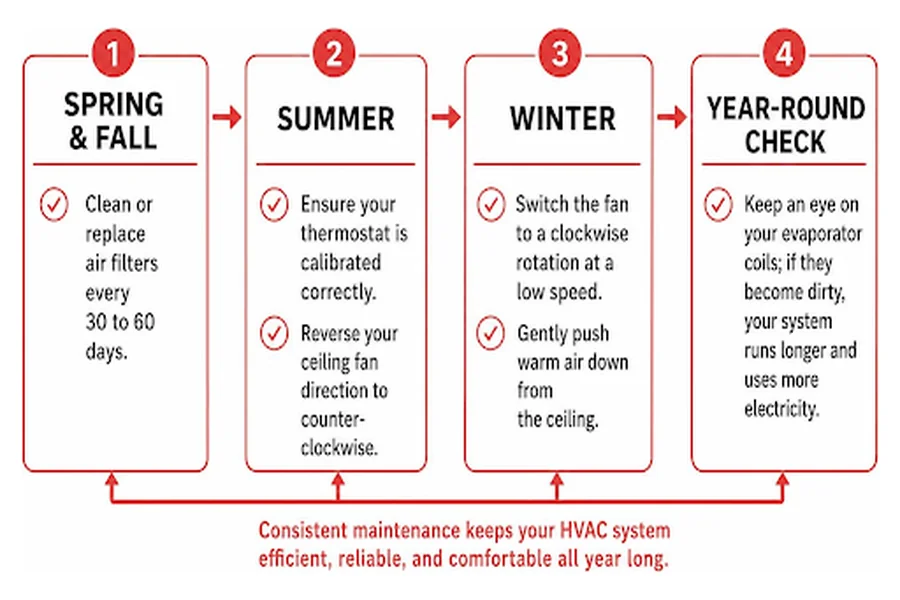
During the spring and fall, focus on cleaning or replacing air filters every 30 to 60 days, especially if you share your home with pets. In the summer, ensure your thermostat is calibrated correctly and consider reversing your ceiling fan direction to counter-clockwise; this creates a wind-chill effect that allows you to raise the thermostat setting without sacrificing comfort. In the winter, switch the fan to a clockwise rotation at a low speed to gently push warm air down from the ceiling. Additionally, keep an eye on your evaporator coils; if they become dirty, they cannot effectively absorb heat, which forces your system to run longer and consume more electricity.
Protecting the Envelope: Roof, Gutters, Foundation, and Pest Defense
The “envelope” of your home—the roof, walls, and foundation—acts as the primary barrier against the elements. If this barrier is compromised, moisture can enter the structure, leading to wood rot, mold, and structural instability. Your gutters are the first line of defense in this process. By directing water away from your foundation, clean gutters prevent the soil around your home from becoming oversaturated, which is a leading cause of foundation settling, hydrostatic pressure buildup, and basement leaks.
Aim to inspect your roof and clear your gutters at least twice a year, ideally in late spring and mid-autumn. During these inspections, look for missing, cracked, or curling shingles, and examine the metal flashing around chimneys, vents, and skylights where water intrusion frequently begins. Ensure that downspouts extend at least four to six feet away from your home’s perimeter to deposit stormwater safely past the backfill zone. If you notice water pooling near the foundation even after a light rain, it may be time to adjust your grading, add extension pipes, or install a splash block to encourage better runoff away from foundation footings.
Foundation Protection and Structural Pest Exclusion
Foundation health is deeply tied to the ecosystem surrounding your home. Moisture-rich environments are magnets for pests that can cause significant structural damage over time. Termites, carpenter ants, and other wood-destroying insects thrive in damp, dark areas, particularly in crawlspaces with poor ventilation or missing vapor barriers. To mitigate these risks, ensure that all wooden siding, deck posts, and decorative trim are kept at least six inches above the soil line, preventing direct moisture wicking.
If you suspect any unwanted visitors or notice subterranean mud tubes along your foundation walls, it is essential to consult with residential pest control experts who can establish a protective perimeter around your property. These professionals can also help identify subtle entry points that you might miss, such as unsealed gaps around utility penetrations, weep screeds without protective barriers, or attic vents that lack proper fine-mesh wire screening. Regularly trimming tree limbs so they remain at least six feet away from your roofline also eliminates elevated “bridges” that rodents and raccoons use to access your attic insulation.
Exterior Residential Home Maintenance for Siding, Windows, and Drainage
Your home’s exterior siding and window seals are constantly expanding and contracting with seasonal temperature fluctuations. Over time, this natural movement causes exterior caulk to crack, shrink, and pull away, allowing water and drafts to penetrate wall cavities. Every spring, walk the perimeter of your home and inspect the expansion joints around window frames, door casings, and corner boards. Applying a fresh bead of paintable, high-quality silicone or polyurethane caulk can prevent hidden water intrusion and significantly improve your home’s energy efficiency by sealing drafts.
Don’t forget to check your soffit vents and fascia boards for signs of rot, paint peeling, or animal nesting. Proper attic ventilation requires continuous intake through soffit vents and exhaust through ridge vents to maintain balanced airflow. This balanced air movement is critical to preventing ice dams in the winter and attic overheating in the summer, both of which can drastically degrade your roofing materials ahead of their expected lifespan.
Annual Budgeting and Planning for Residential Home Maintenance
One of the most common pitfalls for homeowners is failing to account for the inevitable costs of repairs and capital asset replacements. A widely accepted rule of thumb is to set aside between 1% and 4% of your home’s total market value annually for a dedicated maintenance fund. For example, for a home valued at $400,000, setting aside $4,000 to $8,000 each year builds a reliable safety cushion. Alternatively, some homeowners prefer to budget roughly one dollar per square foot of their home’s living area per year. By keeping these funds in a dedicated high-yield reserve account, you ensure that when major mechanical equipment or structural elements reach their expiration date, the necessary financing is readily accessible without relying on high-interest loans.
Component Average Lifespan Typical Replacement Focus Asphalt Shingle Roof 20–30 Years Structural integrity & leak prevention Furnace 15–20 Years Energy efficiency & safety Central AC Compressor 12–15 Years Refrigerant efficiency & heat exchange Water Heater 8–12 Years Sediment flushing & leak avoidance Dishwasher 9–10 Years Filter cleaning & hose integrity Sump Pump 7–10 Years Float switch check & backup battery Prioritize your spending by addressing high-impact preventive items first. Spending a small amount on a seasonal professional HVAC tune-up, minor roof flashing repairs, or an annual gutter cleaning is significantly cheaper than paying for an emergency compressor replacement, structural mold remediation, or interior water damage restoration. Creating a categorized home maintenance binder or digital spreadsheet allows you to log installation dates, warranty documents, contractor receipts, and part numbers, ensuring you stay ahead of depreciation curves and preserve your property’s resale value.
Year-Round Plumbing, Interior Fixtures, and Life Safety Checks
Plumbing issues often start as “silent” problems that quietly erode building materials and inflate utility bills. A leaking toilet flapper or worn fill valve, for example, can waste hundreds of gallons of treated water per month without producing an audible sound. To detect these quiet leaks, perform a simple dye test: add five drops of dark food coloring to your toilet tank and wait sixty minutes without flushing. If color appears in the bowl, you have a leaking flapper seal that needs immediate replacement.
Your water heater also requires regular maintenance to prevent premature tank corrosion and sediment buildup. Once a year, connect a garden hose to the drain valve at the base of the tank and flush out several gallons of water until it runs clear of mineral flakes. Check the temperature and pressure relief valve by lifting the test lever briefly to ensure water discharges freely. Additionally, inspect your main water shutoff valve and label it clearly so that every family member knows how to isolate the home’s water supply in an emergency.
Life safety protocols should be woven directly into your monthly and seasonal routine. Test your smoke and carbon monoxide detectors monthly by pressing and holding the “test” button, and replace batteries during biannual daylight saving time changes. Modern photoelectric and ionization detectors should be completely replaced after ten years of service. Furthermore, verify that your GFCI (Ground Fault Circuit Interrupter) outlets in wet zones like bathrooms, kitchens, and garages trip and reset smoothly to protect against shock hazards. Finally, clean your dryer lint screen after every cycle, and hire a professional or use a rotary brush kit to thoroughly vacuum the entire exterior dryer exhaust duct once a year to prevent lint accumulation, which remains a leading cause of residential structural fires.
Seasonal Care Checklist: Winter, Spring, Summer, and Fall Tasks
Managing your home’s maintenance is less overwhelming when you break it down into seasonal milestones.
Season Primary Focus Key Tasks Spring Exterior & Drainage Clear gutters, check roof flashing, inspect foundation for settlement cracks Summer HVAC & Efficiency Monitor AC performance, inspect window caulking, service ceiling fans Fall Heating & Safety Service furnace, flush water heater, insulate exposed pipes, sweep chimney Winter Interior & Monitoring Test safety alarms, check attic insulation, inspect for ice dams, test sump pump Frequently Asked Questions About Residential Upkeep
How much should a homeowner budget annually for routine maintenance?
As mentioned, aiming for 1% to 4% of your home’s overall market value is the industry standard. This dedicated fund provides a dependable buffer for both recurring operating tasks, like HVAC filter replacements and pest treatments, as well as capital emergencies, like water heater failures or roof repairs. Homes that are more than twenty years old should allocate closer to the 3% or 4% threshold to offset the wear on aging electrical, plumbing, and structural components.
How often should HVAC filters, smoke alarms, and carbon monoxide detectors be replaced?
HVAC air filters should generally be inspected every 30 days and replaced every 30 to 60 days depending on household size, indoor air quality demands, and whether pets live in the home. Smoke and carbon monoxide detectors have a finite operational life due to sensor degradation; these units must be replaced entirely every 10 years, or every 5 to 7 years for specific standalone electrochemical CO sensors. Replace alkaline backup batteries annually or whenever low-battery chirp indicators sound.
What are the earliest signs of hidden plumbing leaks inside the home?
Beyond unexpected spikes in your monthly utility statements, key warning signs include localized warm spots on tile or hardwood floors, spongy baseboards, peeling paint, or musty smells under sink cabinets. You can verify whether a hidden leak exists by turning off all indoor and outdoor water fixtures and observing your main municipal water meter. If the leak indicator dial or digital flow rate continues to register movement over a twenty-minute period, water is escaping somewhere within your supply lines.
Conclusion
Residential home maintenance is not merely a list of chores; it is a commitment to the health, safety, and longevity of your home. By adopting a proactive approach—scheduling regular inspections, budgeting for repairs, and addressing minor issues before they escalate—you protect your family’s well-being and your financial future. Whether you are performing a seasonal gutter cleaning or bringing in professionals for complex system maintenance, every action you take contributes to a more efficient and resilient home. Stay consistent, stay observant, and enjoy the peace of mind that comes with a well-cared-for property.