
The Truck at the Trailhead: How Mobile Units Serve Outdoor Events Where Infrastructure Ends
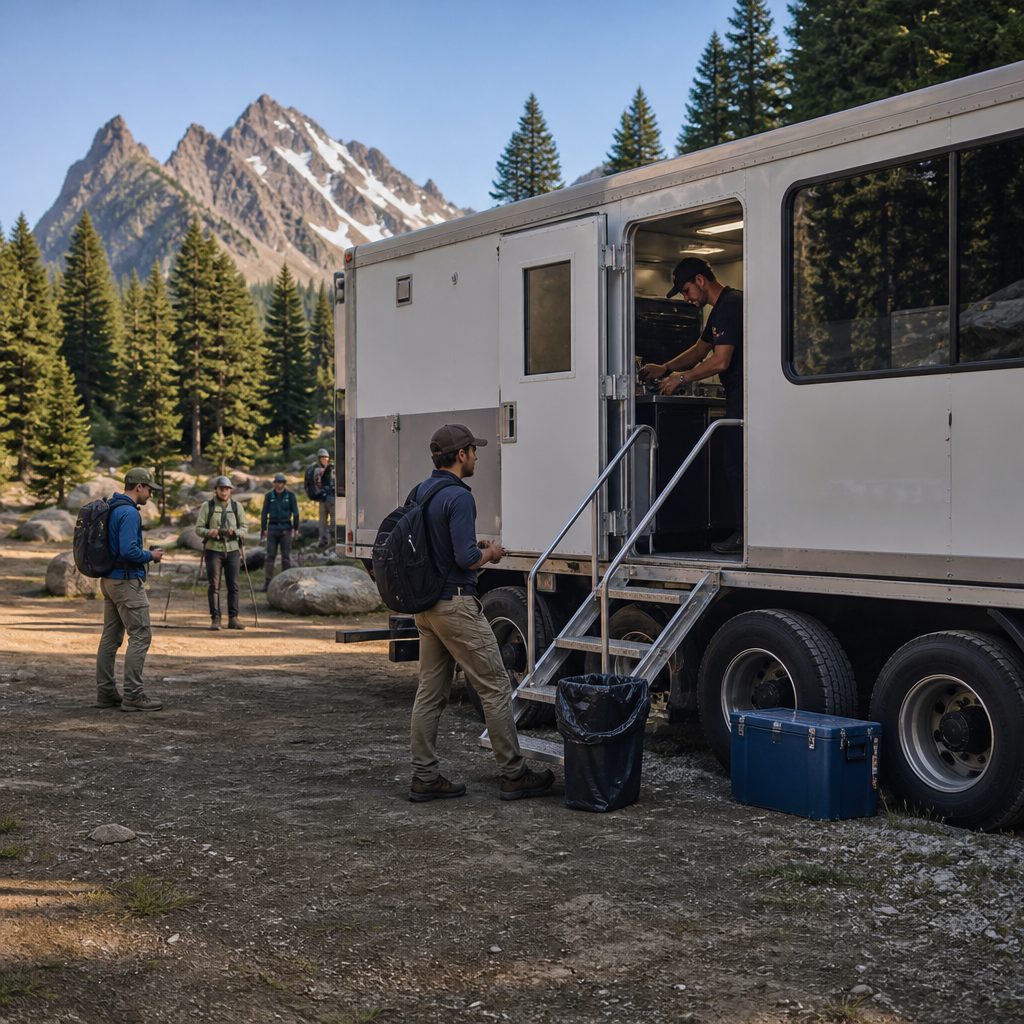
A gravel lot at the end of a forest road is not a venue. There is no three-phase power, no plumbed water, rarely any shade, and often no cell signal worth trusting. Yet that lot is where the race finish, the guided-walk check-in, the first-aid point and the regional tourism stand all have to happen — for three weekends a year. Whatever makes that possible arrives on wheels, and the decisions behind it get made months earlier, usually by someone who has never specified a vehicle before.
Why outdoor venues resist permanent build-outs
Demand at trail destinations is lumpy in a way that punishes fixed infrastructure. A regional trail network might see most of its annual footfall compressed into a handful of weekends tied to snow conditions, autumn color, a festival date or a single race. Building a permanent service pavilion for that peak means heating, insuring and inspecting an empty shell for the other forty-odd weeks.
The physical site adds its own objections. Protected habitat and watershed rules restrict excavation and hardstanding. Frost heave in northern climates wrecks shallow foundations and cracks slabs on a three-to-five-year cycle. Planning consent for anything with a roof can take longer than the funding cycle that paid for the trail in the first place. A wheeled unit sidesteps most of that: it parks, levels, deploys, serves the weekend and leaves the ground more or less as it found it. The trade-off is that everything the building would have provided — power, water, climate control, storage, accessible entry — now has to be carried in and sized correctly in advance.
The vehicle classes that actually show up
Trailers versus self-propelled units
Trailers are cheaper per square foot of usable floor, can be dropped and left on site for a week, and let you keep the tow vehicle working elsewhere. They also demand a competent driver, a reversing plan and turning room that many forest-road lots simply do not have. Self-propelled units — box trucks, cutaway chassis, coach conversions — drive like vehicles, repark easily during an event and need no hitch logistics, but every hour of idle generator time runs through a chassis you also depend on for transport. Where a site has one narrow access track and a single turning head, the self-propelled unit usually wins. Where the unit will sit still for days, the trailer does.
Expandables, glass sides and open-air decks
Expanding sidewalls can roughly double interior floor area once parked, which matters when you need a queue to form inside during rain. Glass-sided and tiered display builds work the opposite way: they keep the public outside and the staff inside, which suits ticketing, equipment demos and gear try-ons. Open-air stage decks that fold out of a trailer shell are the standard answer for award ceremonies and briefings. None of these is universally better — they answer different questions about weather exposure, dwell time and how much of your audience you want under cover at once.
Health services where the map thins out
Outdoor destinations increasingly sit in exactly the communities that struggle for routine clinical access, and the same vehicle logic applies. Analysts tracking the business models and value proposition of mobile health clinics describe units that deliver screening, vaccination and primary care on scheduled routes rather than from a fixed address — a model that maps cleanly onto event medicine. A clinic-grade mobile unit brings a sealed treatment bay, controlled temperature, hand-wash provision and a lockable pharmacy cabinet, none of which a pop-up gazebo can offer. Destination managers who already host a seasonal event often find that the marginal cost of adding a health day to an existing site visit is low, because the parking, signage and crowd flow are solved problems.
Read the route before you specify the vehicle
Specification should follow the itinerary, not the brochure. Walk the route and note where the surface changes, where the last paved turning point is, and where visitors naturally stop. Mixed-theme routes are instructive here: an industry-and-nature themed city walk in Vieremä threads working industrial sites and forest edges into one loop, which means a service vehicle can stage on firm municipal ground while the experience itself happens on soft trail. That pattern — hard edge, soft center — is common and useful. It lets you choose a heavier, better-equipped unit than a purely backcountry trailhead would tolerate, as long as you accept that visitors walk the last few hundred meters.
Sourcing the unit without losing the season
This is where plans stall. A custom build from a bare chassis gives exact control over layout, door placement, axle loading and service panel positions, but the lead time can overshoot a spring opening date. A pre-owned unit refitted and rewrapped can be ready in a fraction of that, at the cost of inheriting someone else’s floor plan. Fabricators who work both sides of that trade-off are the ones worth a conversation: Craftsmen Industries, for instance, handles industrial fabrication, large format graphics and fleet branding alongside mobile specialty vehicles, and lists new and used experiential marketing vehicles for sale, which lets a destination team price a purpose-built trailer against an existing unit before committing a season’s budget. Because the same shop also builds mobile medical vehicles and trailers, a site that needs both a welcome unit and a clinic bay can keep the two on compatible footprints and a single visual identity.
Graphics that survive a season outdoors
Vehicle wraps on outdoor-event fleets fail differently than wraps on city delivery vans. The enemies are UV at altitude, pressure washing to remove mud and road salt, grit abrasion along the lower third of the panels, and freeze-thaw cycling at panel seams and rivet lines. Practical defenses are unglamorous: keep critical type and logos above the splash line, specify laminate rated for the exposure rather than the showroom, avoid large flat areas of a single dark color that will show every scratch, and design so that the two or three panels most likely to be damaged can be replaced without reprinting the whole vehicle. If several units travel together, wrapping them as a recognizable set does more for on-site wayfinding than any amount of signage — visitors learn the color block faster than they read a map board.
Planning backward from the first weekend
Work from the event date to the order date, and resolve the physical constraints before the visual ones:
- Measure the real access route — overhead branches, gate widths, bridge limits, turning radius at the final lot.
- Confirm ground bearing when wet, not when dry, and plan matting for the worst case.
- Size power for peak simultaneous load, then check generator noise against what a nature site can accept.
- Decide who levels, deploys and secures the unit on site, and train a second person to do it.
- Fix the brand and graphics package only after layout and door positions are frozen.
- Budget for one storage season and one wrap repair — both will happen.
Done in that order, the vehicle stops being an expense tacked onto an event and becomes the reason the event can happen somewhere worth going. Done in reverse, you end up with a beautifully wrapped unit that cannot get down the last kilometer of track.