
When Evidence Matters More Than Assumptions in Texas
Key Takeaways
- A traffic ticket may be relevant, but it does not always establish the cause of a crash.
- Texas motorcycle claims can involve more than one potentially responsible person.
- Helmet use and responsibility for causing a collision are separate questions.
- Photos, video, witnesses, vehicle damage, and medical records can clarify disputed facts.
- Evidence should be preserved quickly because footage, memories, and physical marks can disappear.
On a busy Texas roadway, a motorcycle crash can be reduced to a simple assumption too quickly: the rider must have been speeding, riding between lanes, or difficult to see. That assumption can obscure the real sequence of events. After a Texas motorcycle accident, the details surrounding a turn, a lane change, a traffic signal, a blind spot, roadway conditions, and vehicle damage may matter far more than a first impression.
Motorcyclists travel the same highways, frontage roads, neighborhood streets, and crowded intersections as every other Texas road user, but their smaller profile can lead to conflicting accounts after a collision. A fair review should focus on evidence, not stereotypes. That means looking at what both the rider and the other driver did in the seconds leading up to impact.
Why Motorcycle Crash Claims Can Be Complicated
Consider a driver making a left turn across traffic while a motorcycle approaches from the opposite direction. The driver may say the motorcycle appeared suddenly. The rider may say the vehicle turned directly into the motorcycle’s path. An insurer may then focus on the rider’s speed or position in the lane. Each point may deserve review, but none alone necessarily explains the crash.
Motorcycle collisions often involve short time frames, limited visibility, and incomplete recollections. A rider may be hard for another driver to notice, especially among larger vehicles, yet that does not excuse a driver from checking mirrors, blind spots, and oncoming traffic. Texas safety guidance urges motorists to look twice, use signals, check blind spots, and give motorcycles a full lane of space when passing.
Traffic Violations and Crash Causation Are Not Always the Same
A traffic violation can be important evidence, but the violation and the cause of a particular injury are related questions, not always identical ones. Investigators may need to examine sightlines, traffic signals, road markings, weather, braking distance, speed, turn timing, and the direction each vehicle was traveling.
For example, a rider may be accused of an unsafe lane position while a driver changed lanes without signaling or checking a blind spot. The central question is not simply whether one person made a mistake. It is whether that conduct contributed to the collision and, if so, to what extent. Readers should avoid guessing about speed, distance, or lane placement when they cannot clearly remember it.
Lane Position, Visibility, and Helmet Use
Understanding lane-related disputes
Terms such as lane position, lane sharing, lane splitting, and lane filtering are often used loosely after a crash. Their meaning can matter. Lane position generally refers to where a rider was traveling within a lane. Lane splitting commonly describes riding between lines of slow-moving or stopped traffic. Witness descriptions may differ because a motorcycle can move through a traffic scene differently than a passenger vehicle.
Photos of lane markings, vehicle locations, debris, and impact damage may be more reliable than broad statements that a rider “came out of nowhere.” Roadway construction, merging traffic, sun glare, parked vehicles, and large trucks can also affect what a driver could see.
Helmet questions should remain separate from fault
Helmet use may become relevant when evaluating the type or severity of a head injury, but it does not automatically answer who caused the collision. Medical evidence may be needed to determine whether helmet use had any connection to a particular claimed injury. Motorcycle helmets can help protect a rider’s brain in a serious crash, which makes helmet use an important safety decision regardless of how fault is ultimately assessed.
Shared Responsibility in Texas Motorcycle Crashes
More than one person may contribute to a collision. Texas uses proportionate-responsibility rules in civil injury cases, so the conduct of every involved party can be examined. A claimant who is found more than 50 percent responsible generally cannot recover damages, while a claimant who is 50 percent or less responsible may have damages reduced by that percentage.
Facts that may be reviewed include:
- An unsafe left turn or failure to yield.
- An unsignaled lane change or failure to check a blind spot.
- Distracted driving, tailgating, speeding, or unsafe passing.
- A rider’s speed, visibility, braking, and position before impact.
- Road conditions, traffic flow, and the actions of additional vehicles.
Fault percentages should be based on evidence, not on the automatic assumption that a motorcyclist is reckless or that a larger vehicle is always at fault.
Evidence That Can Help Rebuild the Crash
Useful evidence often becomes harder to find with every passing day. A practical preservation checklist includes:
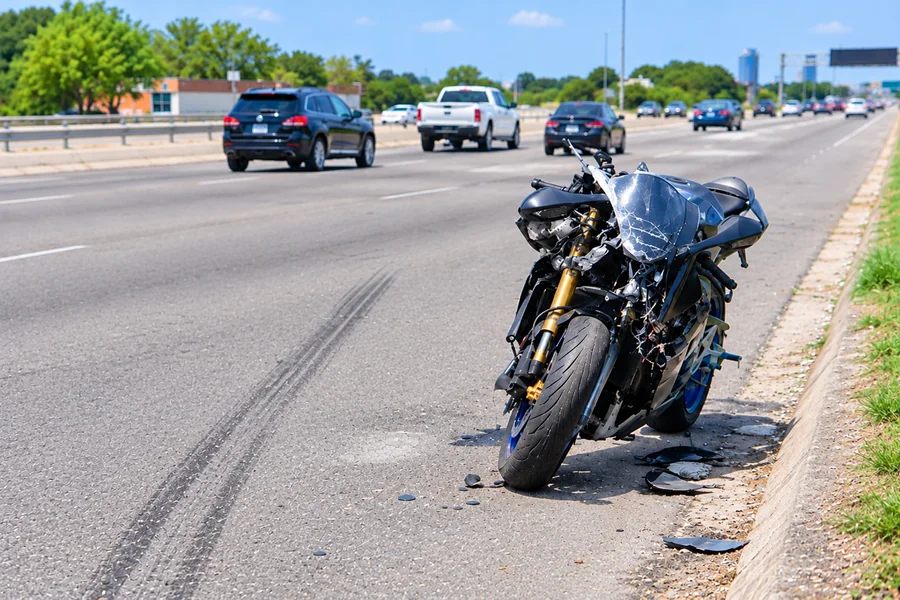
- Scene photographs: Capture lane lines, signs, debris, skid marks, lighting, road damage, and vehicle positions when it is safe to do so.
- Vehicle and motorcycle damage: Photograph all visible damage before repair, disposal, or major alteration.
- Video recordings: Quickly identify dash cameras, traffic cameras, nearby businesses, and residential doorbell cameras, as recordings may be overwritten.
- Witness information: Save names and contact details, then write down what each person observed.
- Riding gear: Preserve the helmet, jacket, gloves, boots, and other equipment in post-crash condition.
- Medical documentation: Keep emergency records, imaging results, prescriptions, therapy notes, and work restrictions.
- Electronic information: Vehicle data, phone records, or navigation history may sometimes help establish timing and movement.
Common Mistakes After a Crash
People are often shaken, injured, or under pressure after a collision. Still, several choices can make a later claim more difficult: admitting fault before all facts are known, estimating speed without confidence, repairing the motorcycle before it is documented, posting crash details online, or accepting an early settlement before the full medical outlook is clear.
A safer approach is to seek appropriate medical care, report the crash, preserve property, write down a factual account while memories are fresh, and answer insurance questions honestly without speculation. If a question is unclear, it is reasonable to say that the answer is unknown rather than guess.
Documenting Injuries and Financial Losses
Motorcycle crash losses can extend beyond the first emergency bill. Documentation may include follow-up treatment, rehabilitation, prescriptions, missed work, reduced earning ability, pain, disfigurement, and limits on daily activities. The value of a claim depends on the specific injuries, available coverage, supporting evidence, and allocation of responsibility. A generic settlement estimate cannot account for those individual facts.
When a Legal Review May Be Helpful
A prompt legal review may be useful when injuries are serious, fault is disputed, lane position is central to the claim, helmet use is raised as an issue, multiple vehicles may share responsibility, or important video evidence needs to be preserved. It can also be helpful when insurance coverage is unclear or crash-related injuries affect a rider’s ability to work.
Frequently Asked Questions
Can a rider still have a claim if an insurer blames the rider?
Yes. An insurer’s initial position is not the final determination of responsibility. The available evidence should be reviewed to assess the conduct of everyone involved.
Does not wearing a helmet automatically eliminate a claim?
No. Helmet use may be discussed in connection with particular injuries, but it does not automatically decide who caused the crash.
What should be preserved first?
Photographs, video, witness contact information, the motorcycle, damaged gear, medical records, and the crash report number are all important starting points.
Conclusion
Texas motorcycle crash claims should be built on a complete factual record. A disputed lane position, a citation, helmet use, or an initial assumption may become part of the discussion, but none should replace careful evidence about what happened before impact and how the crash changed the rider’s life.