
Custom Springs from Hagens for Mechanical Design Engineers
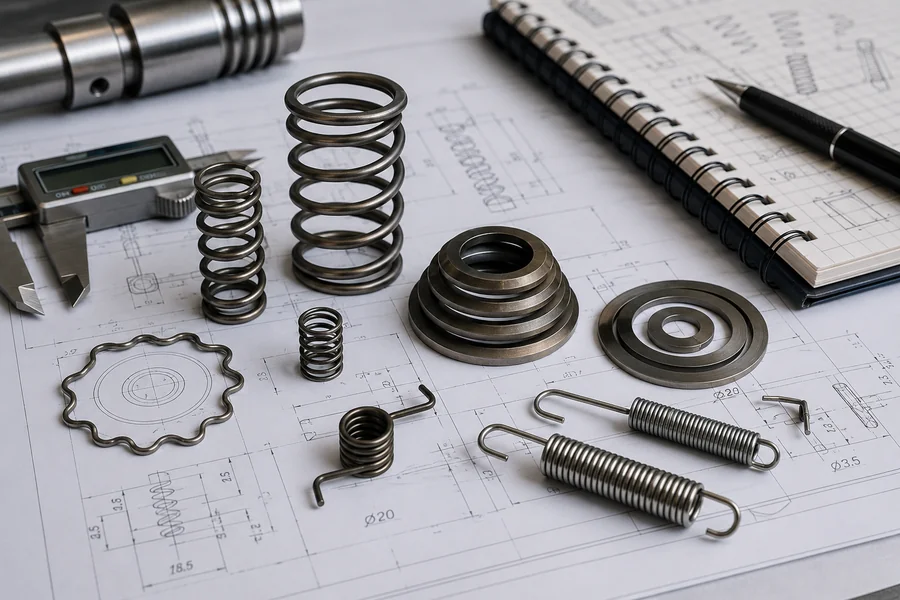
Hagens is a global manufacturer of specialized springs, stamping parts and metal components for industrial machinery and high-end applications. Their custom spring service is designed for mechanical design engineers who encounter situations where standard catalogue springs cannot meet required dimensions, load characteristics or performance criteria.
When Standard Catalogue Springs Fall Short
Catalogue springs solve most routine problems. They come in predictable sizes, standardised wire diameters and documented load ratings. But mechanical design rarely stays routine for long.
The moment your space envelope shrinks below standard dimensions, or your load curve needs to be non-linear, catalogue options disappear fast. The same applies when operating temperatures exceed 120 degrees Celsius, when corrosive environments demand exotic alloys, or when spring geometry must conform to an assembly designed around other components first. Fatigue life requirements beyond 10 million cycles will push most off-the-shelf solutions past their reliability threshold, eliminating entire categories of standard product from consideration before a single dimension has been checked.
Hagens Custom Spring Manufacturer works from application constraints outward rather than forcing a design around available catalogue geometry. The difference shows up in service life, packaging efficiency and overall system performance.
How to Specify a Custom Spring Correctly
Getting a custom spring right starts before you contact a manufacturer. Incomplete specifications lead to revisions that cost weeks.
Follow these steps in sequence:
- Define the maximum space envelope. Document the bore diameter, outer diameter limit and maximum free length available in the assembly. Include any adjacent component clearances.
- Establish load requirements at specific deflection points. A spring rate alone is rarely sufficient. Specify force at installed height, force at maximum working deflection and any preload conditions.
- Determine the operating environment. Temperature range, exposure to chemicals or moisture, and whether the spring will see dynamic or static loading. This drives material selection.
- Identify fatigue life expectations. State the required number of cycles and the deflection range per cycle. This single parameter eliminates entire material and geometry options early.
- Select the appropriate spring type. Compression, tension, disc or wave. Each suits different load profiles and packaging constraints. If unsure, describe the function and let the manufacturer recommend.
- Document end condition and mounting requirements. Closed and ground ends, hooks, loops, or interference fits all affect manufacturability and cost.
Bringing this information to the first conversation with Hagens means the design review can focus on optimisation rather than basic requirements gathering.
Working with Hagens on a Project Basis
Ordering a custom spring is not the same as buying from a catalogue. At Hagens, each project begins with a joint review of the application requirements, identifying potential issues before any tooling is committed.
Spring design involves trade-offs. Increasing fatigue life might require a larger wire diameter, which changes the spring rate. Reducing free length might demand a different material grade. These interactions are best resolved when manufacturer and design engineer work through them together, early in the process.
Hagens also produces stamping parts, clips and other metal components, giving broader manufacturing context when a spring interacts with custom brackets or retention features. Products are built to international standards, supplied globally based on individual customer specifications.
Spring Types Available for Custom Design
Hagens offers customisation across four main spring categories:
- Compression springs. The most common type. Suited to applications requiring resistance to axial compressive force, from valve return mechanisms to industrial press tooling.
- Tension springs. Designed to resist pulling forces. Used in counterbalance systems, door mechanisms and applications where stored energy must be released in tension.
- Disc springs. Compact, high-load capacity in minimal axial space. Ideal for bolted joint preload, overload protection and short deflection requirements.
- Wave springs. Occupy less axial space than coil springs at equivalent loads. Common in bearing preload, seal energising and space-constrained rotary assemblies.
Any standard spring from the Hagens digital catalogue can serve as the starting geometry for a customized version.
Where Custom Spring Projects Go Wrong
The most frequent failure mode is under-specifying fatigue requirements. Engineers state a load and deflection but omit cycle life expectations. The result is a spring that meets static requirements but fails within months of service.
Second is engaging the manufacturer too late — when the surrounding assembly is already frozen, wire diameter, coil count and end conditions become over-constrained by decisions made without spring geometry in mind. Third is treating a custom spring as a drop-in swap for a failed catalogue part without reviewing why the original failed: if the failure was fatigue-driven, a dimensionally identical custom spring in better material may still fail if the root cause was excessive deflection range per cycle.
Skipping prototype validation rarely saves money. A single prototype run catches tolerance stack issues, resonance problems and installation interference before production quantities are committed.
Getting the Specification Right Early
Custom springs are an engineering decision, not a last resort. The earlier a specialist manufacturer is involved, the more precisely the final component can be optimised. Getting the specification right from the outset saves redesign effort and ensures the spring performs reliably across its intended service life.