
Pharmaceutical storage that scales without sacrificing control
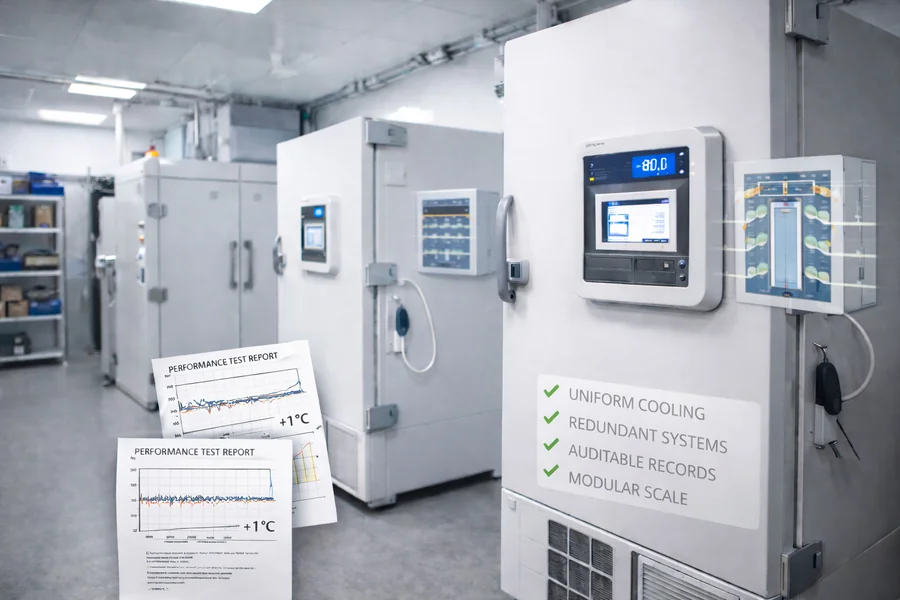
When people talk about pharmaceutical storage, they often jump straight to temperature setpoints. But in real facilities, control is bigger than a number on a display. It’s the combination of stable conditions, predictable workflows, and defensible documentation—especially when a deviation investigation or audit forces you to prove that your materials stayed protected.
That’s why storage planning should begin with risk questions: What happens during frequent access? How quickly does the environment recover? What is your plan when a component fails at the worst possible time? A cold-chain incident is rarely “just a maintenance issue”—it can become a quality event with real schedule and cost consequences.
Stability is not a slogan—ask for evidence
In regulated environments, the difference between “it should be fine” and “we can show it was fine” matters. Stable conditions help prevent temperature excursions that can compromise vaccines, biologics, and other sensitive medicines.
That’s why it’s reasonable to ask vendors for documented performance information, not just brochure language. The target page highlights documented test results and resources intended to help engineers evaluate system structure and operational fit (including a virtual showroom concept).
A practical way to keep discussions grounded is to align on a shortlist of evaluation points:
- Temperature uniformity across the entire storage environment (not a single sensor)
- Failure behavior and redundancy (mechanical and electrical)
- Monitoring readiness and how quickly you can produce usable records
- Qualification/validation support (data you can reference during audits)
- Serviceability: planned maintenance vs. disruptive downtime
Scaling beyond “more upright freezers”
Many sites grow by adding upright units one by one. It works—until floor space, power draw, and alarm fatigue start to dominate daily operations. At that point, scaling becomes less about buying another freezer and more about choosing a storage architecture that grows without multiplying failure points.
This is where consolidated, modular approaches can make sense. On the LOWENCO page for the pharmaceutical industry, they describe low-temperature storage systems with a duct design intended to support uniform cooling, claiming ±1°C variation from setpoint across the storage environment, and a large-scale storage unit designed with fully redundant mechanical and electrical systems.
They also present consolidation and efficiency claims (e.g., reducing energy consumption and operational costs by up to 76%, and substituting up to 42 standard freezers while freeing up 75% floorspace)—useful as benchmarks to validate against your facility, workflows, and qualification expectations.
Where to start if you’re building a storage roadmap
If you’re making decisions today for tomorrow’s pipeline, begin with two realities: temperature range needs and growth pace. The target page notes a range from +10°C down to -80°C, which can matter for facilities balancing cold, freezer, and ULT requirements.
For a clear example of how vendors frame pharmaceutical-specific requirements—stability, scalability, redundancy, and the supporting resources to evaluate performance—you can review this overview of pharmaceutical cold storage.