
RF Power Meter Calibration: Ensuring Reliable RF Measurements
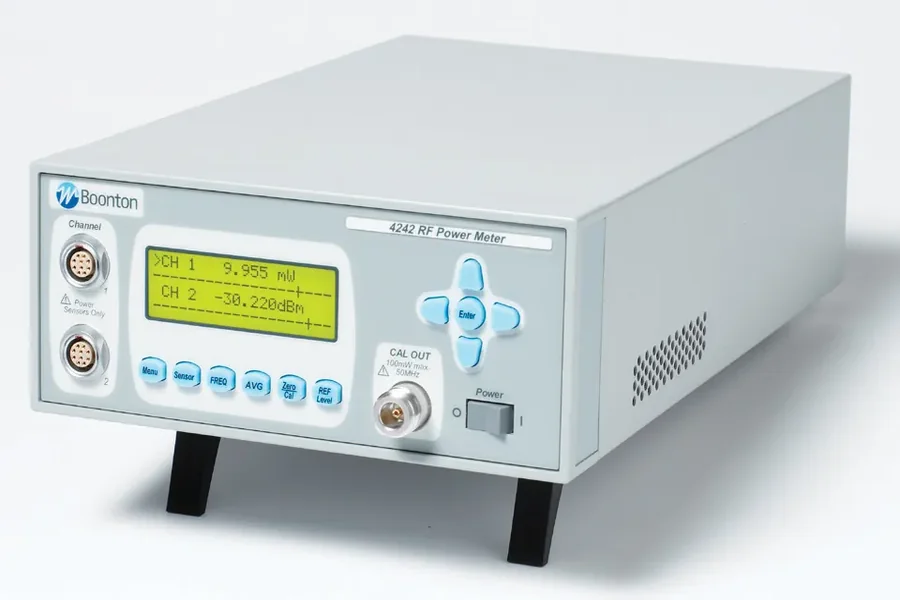
In regulated industries such as aerospace, telecommunications, and defense, the accuracy of radio frequency (RF) measurements is paramount to product performance and regulatory compliance. The RF power meter is a fundamental instrument in these fields, providing critical data on signal amplitude and transmission quality. Due to factors like drift, component aging, and high-power exposure, RF power meter calibration is not merely a best practice but a necessary process to maintain the reliability of these instruments and the integrity of the systems they measure. This article explores the technical necessity, methodologies, and critical considerations for maintaining calibrated RF power meters in high-stakes environments.
The Role of RF Power Meters in Critical Systems
RF power meters are essential for verifying key performance indicators in any system that generates or transmits electromagnetic energy. Applications range from ensuring the output power of a transmitter meets FCC or CE regulatory limits to characterizing the gain and loss across complex antenna systems and microwave links. An uncalibrated power meter can lead to catastrophic errors. For instance, an erroneously low reading might cause an engineer to over-drive an amplifier, leading to system failure or violation of regulatory emission limits. Conversely, an erroneously high reading could result in an underpowered system that fails to meet operational specifications.
Technical Principles of RF Power Meter Calibration
The core process of calibration involves comparing the device under test (DUT)—the power meter and its associated sensor—against a primary power standard. This standard might be a highly stable, traceable thermistor or calorimeter designed to absorb all incident RF energy and convert it to heat, which is then measured with high precision.
Key methodologies require a systematic verification of the meter and sensor performance across the operational range. This includes sweeping power levels to verify linearity and sweeping frequencies to characterize the sensor’s effective efficiency and frequency response. The goal is to correct for the inherent losses and mismatches that occur at high frequencies. Due to the complexity of RF signal path analysis, this calibration must maintain an unbroken chain of traceability to national standards like the National Institute of Standards and Technology (NIST) to ensure the metrological integrity of the measurements.
Key Calibration Parameters and Uncertainty Analysis
In RF metrology, the raw reading from the power meter is insufficient; engineers must account for several critical parameters that contribute to the overall measurement uncertainty. The effective efficiency of the sensor is a ratio of the measured power to the true power, which varies significantly with frequency. Similarly, mismatch uncertainty, arising from imperfect impedance matching between the source, the connecting cable, and the sensor, must be calculated and factored into the final measurement result.
The technical requirement in regulated industries is to achieve low uncertainty. Selecting an accredited laboratory for RF power meter calibration is paramount. A provider with ISO/IEC 17025 accreditation confirms that their procedures, personnel, and equipment are technically competent to handle the sophisticated requirements of microwave and millimeter-wave testing.
Choosing the Right Calibration Partner
Given the complexity and regulatory weight of RF measurements, selecting the right calibration partner is a strategic decision. You need a partner capable of handling the entire scope of your test equipment. SIMCO, for example, offers specialized, accredited services for sophisticated RF and microwave test equipment, ensuring that all calibration procedures adhere to stringent quality and technical requirements. Their approach involves using highly stable primary standards and meticulously characterizing the sensor’s performance over frequency.
Calibration Intervals and Environmental Factors
The appropriate calibration interval for an RF power meter is determined not just by the manufacturer’s recommendation, but also by the usage frequency, the type of power being measured (e.g., high-power vs. low-power), and the stability of the operating environment. A device used daily on a production line will likely drift faster than one used only for periodic R&D.
Environmental stability is a major factor in measurement reliability. RF components are susceptible to thermal effects; therefore, the ambient temperature and humidity must be stable and controlled during the calibration process to minimize thermal drift in the sensitive sensor elements. Skipping the mandatory warm-up time for both the meter and the standards before calibration can render the entire process invalid.
Maintaining Compliance and Data Integrity
In the audited environment of aerospace or medical device manufacturing, maintaining rigorous documentation is just as important as the physical calibration itself. Comprehensive documentation must include detailed “as found” and “as left” data, the specific standards used, and a clear statement of measurement uncertainty.
A qualified service provider like SIMCO delivers the comprehensive calibration reports essential for audits and maintaining the quality management systems required in regulated industries. They provide the necessary data and assurance that your RF power measurements are reliable, traceable, and compliant, minimizing risk and ensuring the integrity of your critical systems.